


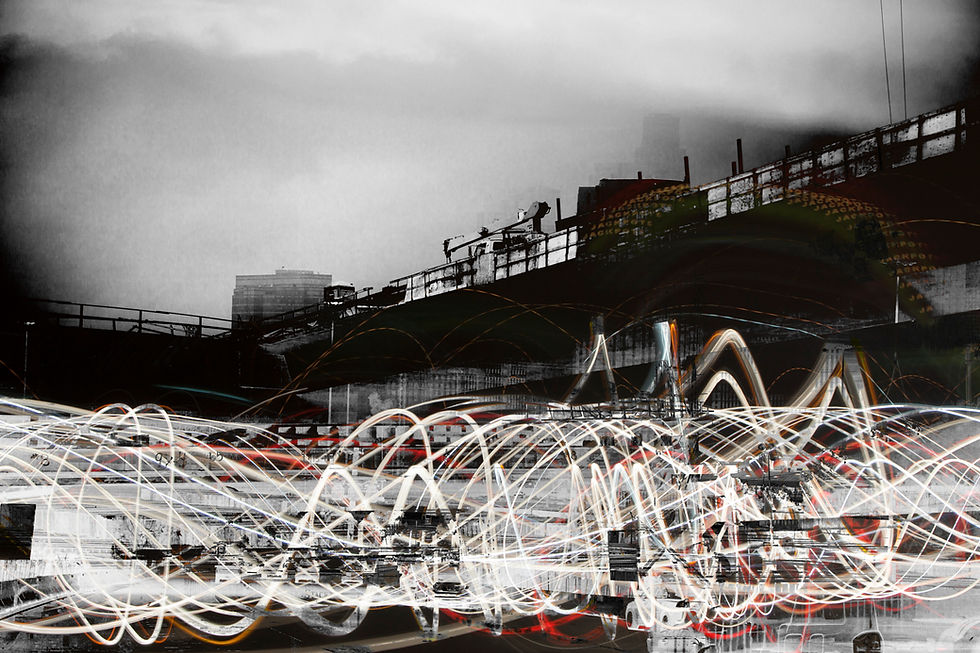


Fatemeh Burnes’ Drift: An Avant-Garde of Book Tradition
by Tyler Stallings
Fatemeh Burnes’ Drift is a book. This is a matter-of-fact statement. However, it is a special decision nowadays to want to make a bound book. The long history of artist-made books ranges over centuries, from William Blake to Dada to Dieter Roth and Ed Ruscha, with the latter two considered the progenitors of the genre as it took form in the latter 20th century. They all challenged the concept and definition of the “book,” especially its inherently linear structure and time-based experience.
There has been a paradigm shift just over the past few years, one dominated by online browsing, in which one customarily works through layers of text and image. A non-linear approach is now the new norm. In this sense, a radical gesture today does not so much fragment and reconfigure the book into a sculptural object so much as create a book that is simply bound for page-to-page perusal.
However, the avant-gardist of just a few decades ago shares a goal with today’s “avant-gardist of the traditional”: accessibility to the work by as many people as possible. Thus, we still see book artists of today bypassing traditional exhibition structures and avoiding galleries and museums that charge admission fees, offer limited display space, and limit the duration of exhibition.
In the context of the Southern California art scene, one cannot but refer to Ed Ruscha’s production of small-edition artist books in the 1960s and ‘70s, brief volumes such as Twentysix Gasoline Stations (1962) and Every Building on the Sunset Strip (1966). In their juxtaposition of similar (but ultimately different) images of our everyday world and their deadpan presentation (each book’s title and its contents are one and the same), Ruscha’s hand-sized books suggest a variety of interpretations: commentary on the barrenness and indistinctness of the urban (especially Los Angeles) cityscape: the influence of logos and roadside architecture in America (think Venturi); or, as critics such as Dave Hickey have noted, there could even be religious references – say, to Christ’s Stations of the Cross – in which gas stations fuel not only the religion of commerce in America but the commerce of religion too. Or, in that they represent a path from his native Oklahoma to Los Angeles, perhaps Ruscha was simply inspired by Jack Kerouac’s beatnik travelogue novel On the Road (1957). In fact, Ruscha published another artistic book in tribute in 2009, On the Road: An Artist Book of the Classic Novel by Jack Kerouac.
Ruscha is discussed at length here because he provides obvious context. Fatemeh Burnes’ aesthetic, however, does not share Ruscha’s deadpan quality. His is a conceptual ambiguity more about exploring the construction of meaning through an arrangement of quotidian images. In essence, Ruscha is teaching us how to “see” the world differently—the minimal objective of any artist. Burnes’ images are of landscapes and buildings, both usually absent of people, seemingly sharing some kinship with Ruscha’s sensibility. But this is only a cursory observation.
For Drift the fairer comparison would be to Robert Frank’s Les Américains (The Americans) (1958). In Drift Burnes traverses the world. At one point she focuses on the Nazi concentration camp, Dachau. Frank’s book was a travelogue too, but one across America. At first glance, both Frank’s approach and Burnes’ appear photojournalistic in their seeming straightforwardness. But after a few pages in either, one notes a peculiar use of cropping, focus, and lighting suggesting a highly subjective expression.
In Drift this subjectivity is stressed with three punctuated moments, at the beginning, middle, and end of the book. In each, Burnes’ teenage daughter rests her head in a manner that suggests that the journey through the book constitutes a dream or a prolonged introspection. Turning the pages of a book does often produce such a meditative state, especially when alone.
Importantly, it is the order of the images that matters the most and provides the journey for the viewer. For Robert Frank, there are instances in The Americans in which blank pages emphasize that the viewer should pause at the adjoining image rather than view it as just one among many. Other times, there are moments at which purposeful juxtapositions highlight the ironies of American culture that made impressions on him.
As in Frank’s, there is a feeling of urgency in Burnes’ book. It is as though her travels around the world are a circling around a subject she cannot yet face. Specifically, she arrives at Dachau. The concentration camp opened in 1933, was the Nazis' first, and served as a model for others. More than 30,000 people were murdered there, while thousands of others died of starvation and torture.
Frank’s artist book of photographs is full of people, but he depicts them as victims of America. In Burnes’ book, there are practically no people, but for her daughter. The effective absence of people, yet the presence of buildings once occupied by people, whether modern day structures or the memorialized barracks of Dachau, suggest a world haunted by the victims of the world.
Numerous exhibitions of art have taken the Holocaust as subject, both to memorialize victims and to make sense of shocking and ghastly events. One of the first shows in recent memory that exhibited a generation of artists twice removed from the Holocaust (both they and their parents having been born afterwards) with the goal of re-examining Nazi imagery was The (New York) Jewish Museum’s 2002 exhibition, “Mirroring Evil: Nazi Imagery/Recent Art.” Burnes’ book is another example of work created over sixty years later. It is also a testament to how the senselessness of the Holocaust still has an impact that radiates through the decades.
The use of irony was heavy in “Mirroring Evil.” Similarly, the scenery around Dachau and in most of Burnes’ images is beautiful, yet gloom lurks behind the veils of shimmering light through tree limbs. Perhaps Burnes is saying that no amount of beauty can hide the dark deeds that human beings can do to others.
If a grand narrative of connections were made, one might say that Frank depicted the underside of American prosperity in the 1950s and Ruscha depicted the settling in of a culture of solitude and anonymity, while Burnes’ Drift suggests that there might be redemption through beauty. However, on closer inspection, after turning all the pages of her book, Burnes’ work could be considered the most sinister, as it shows that the ghosts of the past occupy their own world, whether Dachau, Orange County, or any number of far-flung geographic points, even if they dwell among lovely scenery and exquisite architecture.
###
Tyler Stallings is the artistic director at Culver Center of the Arts and director of Sweeney Art Gallery at University of California, Riverside. He was chief curator at Laguna Art Museum from 1999 to 2006. His curatorial projects focus on contemporary art, with a special emphasis on the exploration of identity, technology, photography, and urban culture. His photo-based exhibitions and essays in accompanying books include The Great Picture: The World’s Largest Photograph, Backyard Oasis: The Swimming Pool in Southern California Photography, 1945-1982 (contributing essayist), Absurd Recreation: Contemporary Art from China, Truthiness: Photography as Sculpture, Conceptual Photography from the Permanent Collection, and Desmothernismo: Ruben Ortiz Torres, among others. For more information: http://tylerstallings.com.